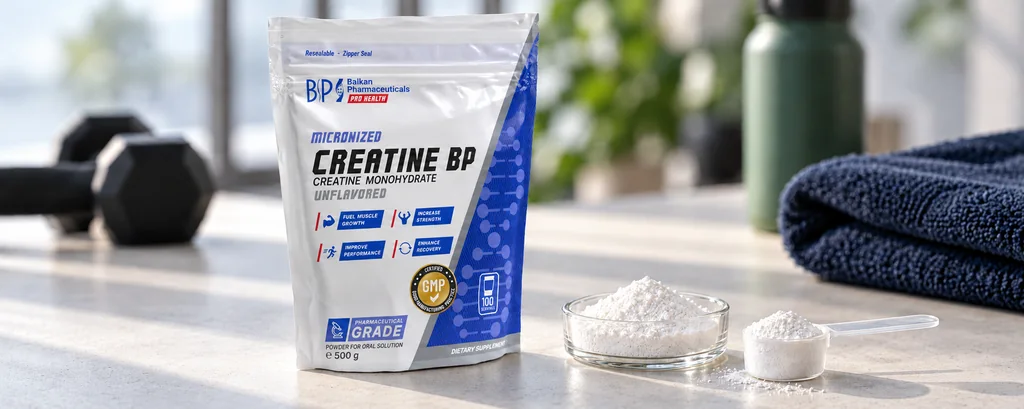
How Long Does Creatine Take to Work? A Realistic Timeline
Published 2026-10-07 · Updated 2026-10-07
How long does creatine take to work? With creatine monohydrate, muscle stores usually build over about 3–4 weeks with 3–5 g daily, or about 5–7 days with an optional loading phase. Workout benefits vary, and visible muscle changes depend on sustained training rather than a fixed supplement deadline. [1] [2]
BalkanFitness sells the creatine product linked in this guide.

How long does creatine take to work? Start with muscle stores
Creatine helps your muscles replenish ATP, the energy used during short, hard efforts such as lifting and repeated sprints. Taking it regularly increases the creatine available in muscle; the time needed to build those stores explains much of the wait. [2]

After swallowing, creatine is absorbed through the intestine into the bloodstream; higher muscle stores build with repeated use rather than instantly in the throat or stomach. [9] [1]
“Saturation” is shorthand for bringing muscle creatine stores toward their upper range. You cannot confirm that point from how a workout feels, and reaching it does not guarantee an immediate personal record.
Optional loading: about 5–7 days
Research commonly uses about 20 g daily, divided into smaller servings, for a short loading phase before a lower daily amount. This builds stores faster; loading is optional, and the larger amount is not the ongoing target. [2]
No loading: about 3–4 weeks
A steady 3–5 g daily approach builds stores more gradually. In Hultman and colleagues’ study, 3 g daily for 28 days produced a similar average increase in muscle creatine to 20 g daily for six days. [1]
These are approximate muscle-store timelines, not promised dates for stronger workouts or visible muscle growth. The Hultman research involved 31 men in small experiments and measured muscle creatine, not when people noticed a difference. [1]
When might you notice a difference?
The first week: changes may be subtle
Early changes in muscle fullness or scale weight can reflect water retention rather than newly built muscle, so they are a poor standalone test of whether creatine is helping your workouts. [3]
Some performance benefits have appeared within a week under study conditions: a trial in 19 trained male handball players found improvements in repeated high-power exercise after five days of loading. It did not improve every outcome, including maximal bench-press strength, so “working” depends on what you measure. [4]
The following weeks: look for repeatable changes
Useful signs might include another controlled repetition at the same load or less drop-off across comparable hard sets. Look for a pattern over several sessions rather than treating one great workout as proof.
If you skip loading, your first week is still early in the process. Keep your exercise selection, rest periods, and technique reasonably consistent so your comparisons mean something.
Over a training block: judge progress in context
In a 12-week trial of 19 resistance-trained men, the creatine group gained more strength and muscle-fiber size than the placebo group while both followed heavy resistance training. That supports a role alongside training, but it cannot tell you when you will see a change in the mirror. [5]
If creatine seems not to be working
Before changing products or taking more, run through these checks:
- Check the actual amount. Read the creatine amount per serving. The total weight of a flavored powder or blend may include other ingredients, and scoops are not interchangeable between products.
- Check consistency. Count the days you actually took it. A month of occasional use is not the same routine as the daily supplementation used in the studies.
- Check the comparison. Different exercises, longer rest periods, or looser technique can make a workout look better without showing a creatine effect. Keep a brief training log.
- Check sleep, food, and hydration. Poor recovery or dehydration can make training feel worse and muddy the comparison. Creatine is not a substitute for those basics; a controlled trial in 12 trained men found that loading did not worsen hydration or heat tolerance under the conditions tested. [6]
- Allow for individual response. In a small biopsy study, the 11 men given creatine showed substantial differences in muscle creatine uptake after loading, with starting stores among the factors associated with response. You cannot identify yourself as a “non-responder” from a few workouts or the absence of a noticeable feeling. [7]
- Do not chase a feeling with larger servings. Bigger single servings can increase digestive problems; a trial in male soccer players found more diarrhea with 10 g at once than with the same daily amount split into two servings. Persistent discomfort is a reason to stop and ask a healthcare professional, not push harder. [8]
When comparing BalkanFitness creatine options, check the selected product’s creatine amount, directions, and other ingredients. Choose a format you can measure accurately and use consistently.
A simple routine for the first month
You do not need a complicated tracking system. Use this as a practical observation plan:
- Before starting: Record the loads, repetitions, and rest periods for two or three exercises you already perform safely. Note your usual sleep and training schedule.
- Each day: Follow your chosen product’s directions and attach the habit to something reliable, such as breakfast. Record whether you took it, including on rest days, rather than relying on memory.
- Each week: Compare similar sessions and note any digestive symptoms. Avoid changing several supplements or your entire program at once if you want a useful comparison.
- At the end of the month: Review consistency and workout trends. If results are unclear, improve the quality of the comparison before assuming a bigger serving or a different product is the answer.
A simple entry is enough: “Tuesday: three sets at the usual load, same rest periods, reps recorded, normal sleep.” This is a self-check, not a controlled experiment; training improvements alone cannot prove how much a supplement contributed.
If you are pregnant or breastfeeding, under 18, have a medical condition such as kidney disease, or take medications, consult a healthcare professional before using creatine.
Quick questions
When does creatine start working if I do not load?
Expect the buildup of muscle stores to take roughly three to four weeks with consistent daily use. That is a useful planning window, not an on/off switch: stores rise gradually, and a clear workout benefit may be harder to notice. Judge a pattern of comparable sessions rather than one date. [2]
Can I judge creatine after my first workout?
No single workout gives you a reliable answer. The studies discussed here used repeated daily supplementation and measured specific outcomes, rather than asking whether participants felt an immediate boost. Record your starting performance, keep your routine stable, and give yourself enough observations to distinguish a trend from an unusually good or bad day.
How long does creatine stay in your system after you stop?
Your body naturally contains creatine, so it never simply disappears. The extra muscle stores built through supplementation decline over weeks; in Hultman’s study, stores returned to roughly their starting level about a month after stopping. That finding describes muscle stores, not an exact clearance time for every person. [1]
Does missing one day restart the timeline?
One missed day is unlikely to erase the buildup, because elevated muscle stores decline gradually rather than disappearing overnight. Resume your normal routine without doubling up to “catch up.” This is a practical inference from the gradual decline seen after stopping, not a trial-tested rule for every missed-dose pattern. [1]
How long should I wait to see results from creatine?
First decide which result you mean: higher muscle stores, better training performance, or a visible change. The first has a clearer research timeline; the others depend on your response and training. Review consistent use and comparable workout records after the first month, without treating an unchanged mirror image as evidence of failure.
Give the routine time, then check the evidence
The most useful approach is to take a clearly measured amount consistently and track what happens in your training.
Explore BalkanFitness creatine options and compare the selected product’s label with the routine you plan to follow. Choose for consistency, not a promise of overnight progress.
References
View all 9 sources
- Hultman E, et al. Muscle creatine loading in men. Journal of Applied Physiology. 1996;81:232–237.
- NIH Office of Dietary Supplements. Dietary Supplements for Exercise and Athletic Performance. Health Professional Fact Sheet. Accessed October 6, 2026.
- Powers ME, et al. Creatine Supplementation Increases Total Body Water Without Altering Fluid Distribution. Journal of Athletic Training. 2003;38:44–50.
- Izquierdo M, et al. Effects of creatine supplementation on muscle power, endurance, and sprint performance. Medicine & Science in Sports & Exercise. 2002;34:332–343.
- Volek JS, et al. Performance and muscle fiber adaptations to creatine supplementation and heavy resistance training. Medicine & Science in Sports & Exercise. 1999;31:1147–1156.
- Watson G, et al. Creatine use and exercise heat tolerance in dehydrated men. Journal of Athletic Training. 2006;41:18–29.
- Syrotuik DG, Bell GJ. Acute creatine monohydrate supplementation: a descriptive physiological profile of responders vs. nonresponders. Journal of Strength and Conditioning Research. 2004;18:610–617.
- Ostojic SM, Ahmetovic Z. Gastrointestinal distress after creatine supplementation in athletes: are side effects dose dependent? Research in Sports Medicine. 2008;16:15–22.
- McCall W, Persky AM. Pharmacokinetics of creatine. Subcellular Biochemistry. 2007;46:261–273.
These statements have not been evaluated by the Food and Drug Administration. This product is not intended to diagnose, treat, cure, or prevent any disease.