Supplement guides · Creatine
Creatine Loading Phase and Cycling: Do You Need Either?
Published 2026-10-13 · Updated 2026-10-13

You can make creatine feel complicated before you have taken a serving: load, maintain, stop, restart. These steps do different jobs, and only some are useful. Loading is an optional way to fill muscle creatine stores faster; maintenance keeps an elevated supply available; cycling introduces planned breaks.
The useful decision is whether a faster increase in stores matters enough to justify a busier first week. A repeating on/off calendar has no established advantage for a healthy adult using creatine monohydrate appropriately. Here is how to separate the evidence from the routine.
What a creatine loading phase actually changes
Your muscles already contain creatine from your body's own production and food. Supplementation can increase those stores, supporting the rapid recycling of energy during repeated high-intensity efforts. Loading uses a higher total daily amount briefly to raise stores faster. It is a starting strategy, rather than a requirement for creatine to work. [1]
In a 1996 muscle-biopsy study involving 31 men, researchers reported a similar increase in muscle creatine with 20 grams daily for six days and with 3 grams daily for 28 days. The study measured muscle creatine, not a promise of identical strength gains for every person. It gives a direct reason why skipping loading remains a valid choice. [2]
| Decision point | Loading, then maintenance | Steady daily use |
|---|---|---|
| Research approach | About 20 g/daySplit into four 5 g portions for 5–7 days; then 3–5 g/day | 3–5 g/dayFrom the start |
| Main advantage | A faster rise in muscle stores | A simpler routine with a smaller daily amount |
| Main trade-off | More portions to remember; large single portions may cause stomach discomfort | A more gradual rise in stores |
| Best practical fit | An adult who values a faster start and tolerates divided portions | An adult who prefers simplicity or wants to avoid high initial intake |
| Scheduled time off? | No established need solely because you loaded | No established need solely because you use it daily |
Amounts refer to grams of creatine monohydrate, not grams of an unspecified flavored powder or a particular brand's scoop. These research examples do not override a product label or individual medical advice. [1]
For the broader expectations after starting, see our guide to how long creatine takes to work.
Do you need to cycle creatine?
For most healthy adults, no. Cycling creatine usually means taking it for several weeks, stopping for a planned interval, and repeating. The reasoning often involves concerns that your body will become dependent, stop producing creatine permanently, or need a reset for the supplement to remain useful.
Those concerns help explain the appeal of cycling, but a precise origin for the practice is hard to establish. The important question is whether planned breaks improve results or safety. The ISSN position stand supports continued maintenance use and does not establish an advantage for routine cycling. A 2021 evidence review similarly explains why loading is optional. [1] [3]
No established need for a performance reset
Your own creatine production can adjust during supplementation. That is different from evidence of permanent suppression. The ISSN review reports no evidence that muscle creatine drops below its original baseline after stopping; levels gradually move back toward baseline. There is no established need for a scheduled break to restore normal production. [1]
Be precise about the strength of that conclusion. It combines creatine-storage research, maintenance studies, and safety evidence. It does not mean a lifelong trial has compared every possible on/off schedule, or that every person should supplement indefinitely. A break can still make sense for personal preference, cost, intolerance, or advice from a healthcare professional.
Practical takeaway: Finishing a container or reaching week eight does not, by itself, create an evidence-based need for time off. Reassess whether the supplement still fits your goals and health circumstances.
The simple verdict
Loading is optional.
Consistency does the work.
A creatine loading phase is optional. It raises muscle creatine stores faster, while a smaller daily amount builds them more gradually. Healthy adults generally do not need to cycle creatine on and off. Choose a routine you can maintain, and distinguish research doses from the directions for your specific supplement.
01 / Loading
A faster start
02 / Steady daily use
A simpler routine
03 / Scheduled cycling
No established need
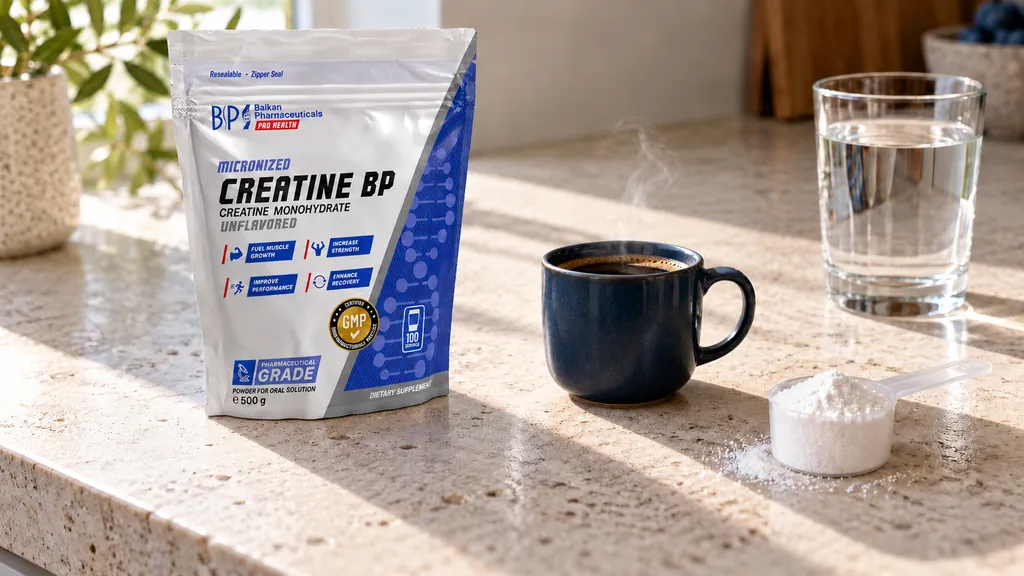
General education for adults. BalkanFitness sells the creatine supplement shown in this guide.

A simple starting routine
For a beginner without an urgent reason to raise stores quickly, steady daily use is the easier starting point. Loading creatine can be reasonable when speed matters, but it adds several portions to the day. Choose the approach before starting so that a higher initial amount does not accidentally become your long-term routine.
Option 1 · Keep it simple
Start with maintenance
Research commonly uses 3–5 grams of creatine monohydrate daily without an initial loading phase. Tie it to a regular meal or another reliable habit. Consistency matters more than building an elaborate calendar.
Option 2 · Faster starting approach
Load briefly, then reduce
A common research protocol uses about 20 grams daily in four separate 5-gram portions for 5–7 days, followed by 3–5 grams daily. Do not take the entire loading amount at once. [1]
Whichever route you choose, count the actual creatine listed per serving. A scoop of a flavored supplement may include other ingredients, so powder weight and creatine weight are not automatically interchangeable. Do not stack several creatine-containing products without accounting for the total.
Rest days do not automatically require a break: maintenance is aimed at keeping muscle stores elevated, rather than acting only at the moment of a workout. If your routine becomes difficult to follow, simplifying it is more useful than adding new loading and stopping rules.
Who should be cautious?
Healthy-adult research should not be treated as a personal safety clearance. If you have kidney disease or another chronic condition, take medication, are pregnant or breastfeeding, or are under 18, consult a qualified healthcare professional before using creatine.
Watch tolerance during higher intake
Stomach discomfort is a practical reason to skip loading. In a small, 28-day trial of 59 male soccer players, a single 10-gram serving was associated with more diarrhea than two separate 5-gram servings. This supports avoiding large single portions, although one small study cannot predict your individual tolerance. [4]
Early weight gain can reflect increased body water; it is not proof of equivalent new muscle tissue. If a rapid change on the scale would be inconvenient, that is another reason to favor a gradual approach. Persistent or concerning symptoms deserve medical advice rather than repeated loading attempts. [3]
Tell your clinician before kidney-function testing
Creatine supplementation can affect serum creatinine, a marker used to estimate kidney function. A higher creatinine result alone does not establish kidney injury, but it should not be dismissed without clinical interpretation. Tell your clinician what you take so they can interpret results in context. Reviews in healthy adults are reassuring about recommended use; they do not remove the need for individualized care. [5]
Quick questions about loading and cycling
Should you cycle off of creatine after eight weeks?
There is no established requirement for a healthy adult to stop solely because eight weeks have passed. Continued maintenance use is supported by the broader evidence. Reassess your goals, tolerance, and medical circumstances, and clarify any product directions that conflict with a general guide rather than ignoring the label.
Is a creatine loading phase necessary every time you restart?
No. Loading remains optional when you restart, just as it is when you first begin. A steady daily amount can raise stores gradually. After a longer break, the choice depends on how much you value a faster increase and whether higher divided amounts suit your health circumstances and tolerance.
Do you need to cycle creatine to keep it effective?
Research does not establish that scheduled breaks restore or improve creatine's effectiveness. Maintenance use is intended to keep muscle stores elevated. A plateau in training is not, on its own, evidence that you need to cycle; training progression, food, sleep, and recovery also influence the results you notice.
Can you take the whole loading amount at once?
That is not the usual research approach. A common loading protocol divides about 20 grams across four 5-gram portions during the day. Larger single servings can be harder on the stomach. If those extra portions are inconvenient or poorly tolerated, skipping the loading phase is a reasonable alternative.
How long is a creatine cycle supposed to last?
There is no standard evidence-based on/off cycle that healthy adults must follow. An optional 5–7-day loading phase is different from a repeating cycle: it is followed by maintenance, not an automatic stop date. Your reason for use, the verified product directions, and any relevant clinical advice should guide continuation.
The bottom line
A creatine loading phase is a choice about speed and convenience. Steady daily use is a valid starting option, and routine cycling has no established benefit for most healthy adults. Pick a manageable approach and check what your actual supplement contains.
References
- Kreider RB et al. International Society of Sports Nutrition position stand: safety and efficacy of creatine supplementation in exercise, sport, and medicine. Journal of the International Society of Sports Nutrition, 2017.
- Hultman E et al. Muscle creatine loading in men. Journal of Applied Physiology, 1996. Human muscle-biopsy study; 31 men.
- Antonio J et al. Common questions and misconceptions about creatine supplementation: what does the scientific evidence really show? Journal of the International Society of Sports Nutrition, 2021.
- Ostojic SM, Ahmetovic Z. Gastrointestinal distress after creatine supplementation in athletes: are side effects dose dependent? Research in Sports Medicine, 2008. Trial; 59 male soccer players.
- Longobardi I et al. Is it time for a requiem for creatine supplementation-induced kidney failure? A narrative review. Nutrients, 2023.
These sources evaluate creatine generally. None is presented as a clinical trial or medical endorsement of the pictured Balkan Pharmaceuticals product.
This article provides general educational information and does not replace personalized medical advice. These statements have not been evaluated by the Food and Drug Administration. This product is not intended to diagnose, treat, cure, or prevent any disease.