Can You Mix Creatine With Protein Powder?
Educational content. Not medically reviewed. General information, not individualized advice.
Quick answer
Yes. You can mix creatine with protein powder in the same shake. Research has studied taking them together, and combining them can simplify your routine. That does not establish that sharing one shaker produces better results than taking the same supplements separately. Burke et al., 2001
Check the ingredients already in each product, your tolerance and the prepared drink’s storage needs.
In this article
- Quick answer
- Why mix creatine with protein powder?
- How to make a creatine and protein shake
- What happens to creatine after you mix it into liquid?
- When separate servings make more sense
- Timing without an elaborate schedule
- Common mistakes to avoid
- Who should get individual advice first?
- The takeaway
- References
Why mix creatine with protein powder?
The main everyday advantage is convenience: one preparation step instead of two. If you already drink a protein shake, it can be an easy place to include a separately measured creatine serving.
The ingredients serve different purposes. Dietary protein supplies amino acids, while creatine supports the phosphocreatine system involved in rapid energy supply during intense activity. Creatine is made in the body from amino-acid precursors, but it is not itself dietary protein and should not be counted toward your protein total. ISSN creatine position stand
A powder’s product name is not enough to determine what it supplies. “Protein powder with creatine” describes a combination product; plain creatine monohydrate and plain protein powder are different ingredients.
What the combination studies actually show
In a six-week randomized trial of 36 men doing resistance training, researchers compared whey protein, whey plus creatine, and a carbohydrate placebo. The combination group improved more in some outcomes, including lean tissue mass and bench press strength, but not in every strength measure. Burke et al., 2001
That is evidence about a supplementation program during training. The trial did not compare the same protein and creatine amounts mixed in one bottle against those same amounts taken separately, so it cannot prove an advantage from the act of mixing them.
A different study in 12 men found similar increases in short-term creatine retention with protein plus carbohydrate and with a larger carbohydrate-only serving. Protein was not shown to outperform that high-carbohydrate comparison. Nor does the study establish that an ordinary protein shake produces the same effect or greater long-term muscle gain. Steenge et al., 2000
Practical takeaway: combine them if that makes your routine easier. There is no reason to copy a research feeding protocol or add a large amount of sugar just to make a shake seem more effective.
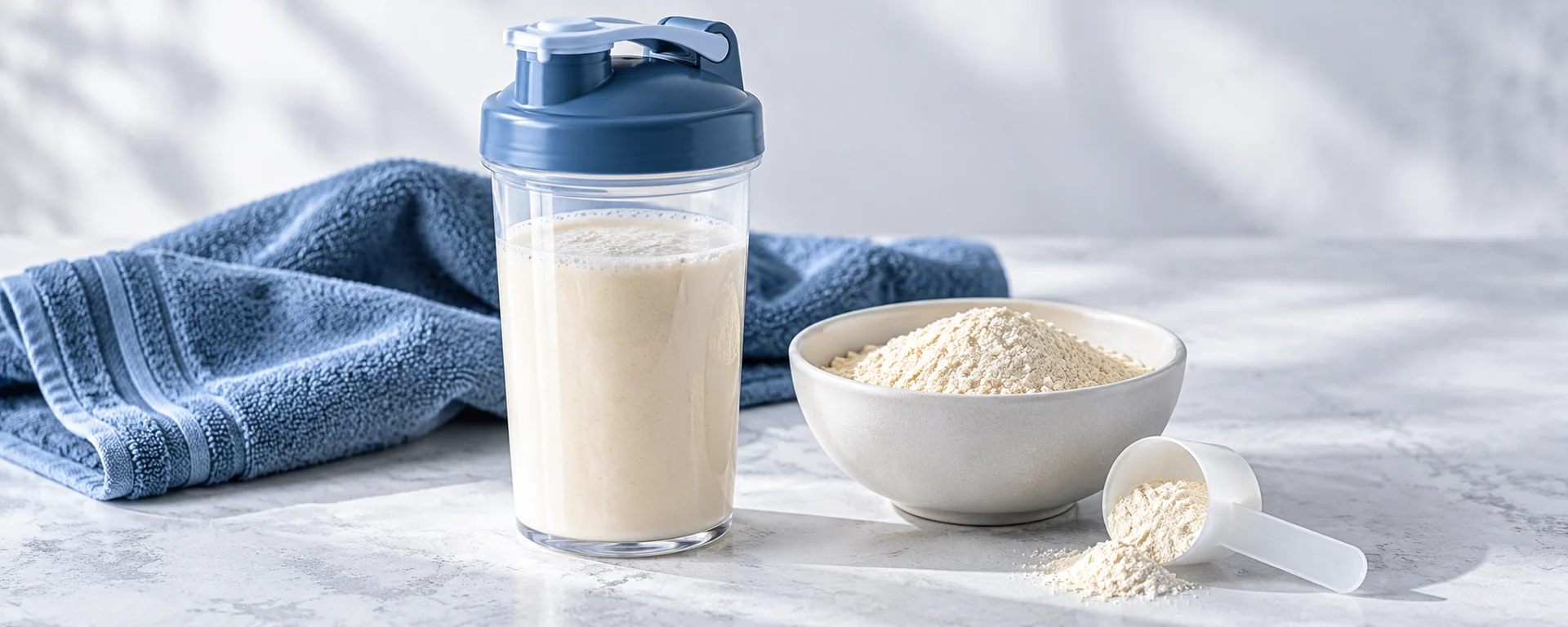
How to make a creatine and protein shake
These are preparation steps, not a personalized supplement prescription. Use the directions for the products you actually own.
- Check the ingredients. Note the creatine already in your protein powder, pre-workout or other blends before adding a separate powder.
- Measure each powder using its own label. Scoops from different containers are not interchangeable. The example below shows how serving size changes the arithmetic.
- Add the labeled liquid amount and mix thoroughly. Choose a suitable beverage, considering allergies and tolerance. Check for powder at the bottom before adding more.
- Prepare close to drinking time. If mixing ahead, follow the food-storage guidance below.
How much liquid should you use?
Start with the amount on the protein product’s label and any instructions on the creatine product. Adding liquid can make a thick shake easier to drink, but there is no established universal ounces-per-gram ratio that makes the combination more effective.
Texture is a practical preference. Your daily fluid needs are a separate question, covered in how much water to drink with creatine.
Read “per serving” carefully
A serving may mean more than one scoop. Check both the serving size and the amount of each active ingredient per serving, rather than judging from the scoop’s appearance.
The card’s half-serving calculation assumes the product is evenly mixed.
If a blend does not disclose enough information to calculate its creatine content, do not guess. Ask the manufacturer or choose a clearly labeled option.
What happens to creatine after you mix it into liquid?
Creatine does not instantly become ineffective when it touches a drink. However, storage conditions matter: in solution, conversion to creatinine can increase with time, warmer temperatures and certain acidic conditions. A review of creatine chemistry describes how pH and temperature affect this process. Kreider, Jäger and Purpura, 2022
That chemistry does not support a universal claim such as “every shake loses its creatine after 30 minutes.” A plain-water mixture, an acidic beverage and a formulated protein drink are different preparations.
A laboratory study of effervescent creatine solutions compared refrigerated and room-temperature storage. It supports the importance of storage conditions, but it was not a test of every homemade protein shake. Ganguly et al., 2003
The simplest approach is to carry the dry powders and add liquid when you are ready. If you mix ahead, use a clean container, keep the drink appropriately chilled and follow its ingredients’ storage directions; refrigeration does not make storage indefinite. For the separate question of dry powder’s shelf life, see our protein powder expiry guide.
Chemical stability and food safety are separate issues
A shake containing milk or other perishable ingredients can become unsafe even when you have no way to detect how much creatine remains. Do not judge its safety by whether the powder still looks mixed.
The FDA advises refrigerating perishable foods promptly and limiting time at room temperature to two hours, or one hour above 90°F (32°C). Those are food-safety limits for perishables, not a creatine-potency countdown. Keep the refrigerator at 40°F (4°C) or below. FDA storage guidance
When separate servings make more sense
Combining powders is optional. Use the arrangement that lets you measure accurately and prepare a drink you tolerate.
Keep the products separate if you do not want a protein shake that day. If a combined drink causes discomfort, pause and review the ingredients and servings rather than repeatedly changing the recipe.
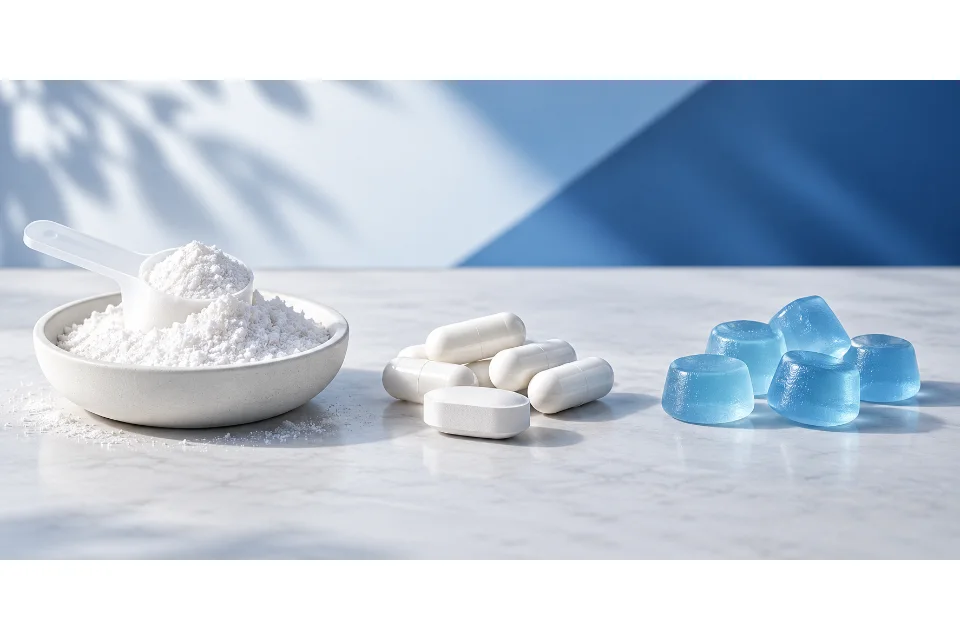
If the powder itself is inconvenient, creatine powder versus pills covers the format decision without requiring you to change your protein routine.
Timing without an elaborate schedule
Use the shake when it fits your day; the studies above do not establish a need to drink both ingredients together immediately after training. On a day without a shake, follow the creatine product’s directions independently. A routine you can follow matters more than copying an elaborate schedule.
Common mistakes to avoid
Using more powder to compensate for a missed shake. Review the product directions rather than doubling ingredients by habit.
Ignoring everything else in the drink. Milk, sweeteners and other ingredients can matter for tolerance. For example, lactose intolerance can cause abdominal bloating, gas or diarrhea after lactose-containing foods or drinks. NIDDK lactose-intolerance information
For choosing between dairy protein types, see whey isolate versus concentrate.
Leaving a perishable shake in a warm car. Use appropriate refrigeration or mix it later; a shaker bottle is not a cooler.
Who should get individual advice first?
A randomized, placebo-controlled study in healthy resistance-trained adults eating a high-protein diet found no impairment in measured kidney function during 12 weeks of creatine supplementation. This is reassuring evidence within that population and duration, not a guarantee for someone with kidney disease. Lugaresi et al., 2013
If you have kidney disease, a prescribed protein or fluid restriction, another chronic condition, take medication, are pregnant or are under 18, discuss both supplements with a healthcare professional first. If a shake causes persistent symptoms, stop and seek advice rather than repeatedly increasing dilution or changing doses.
The takeaway
You can mix creatine and protein powder for convenience. Check the total creatine across products, measure labeled servings and handle the prepared drink appropriately. Taking both in one shaker is an option, not a proven shortcut to better results.
References
- Burke DG et al. The effect of whey protein supplementation with and without creatine monohydrate combined with resistance training on lean tissue mass and muscle strength. International Journal of Sport Nutrition and Exercise Metabolism, 2001.
- Kreider RB et al. International Society of Sports Nutrition position stand: safety and efficacy of creatine supplementation in exercise, sport, and medicine. Journal of the International Society of Sports Nutrition, 2017.
- Steenge GR, Simpson EJ, Greenhaff PL. Protein- and carbohydrate-induced augmentation of whole body creatine retention in humans. Journal of Applied Physiology, 2000.
- Kreider RB, Jäger R, Purpura M. Bioavailability, Efficacy, Safety, and Regulatory Status of Creatine and Related Compounds: A Critical Review. Nutrients, 2022.
- Ganguly S, Jayappa S, Dash AK. Evaluation of the stability of creatine in solution prepared from effervescent creatine formulations. AAPS PharmSciTech, 2003.
- FDA. Are You Storing Food Safely?. Accessed October 17, 2026.
- NIDDK. Lactose Intolerance. Reviewed February 2018; accessed October 17, 2026.
- Lugaresi R et al. Does long-term creatine supplementation impair kidney function in resistance-trained individuals consuming a high-protein diet?. Journal of the International Society of Sports Nutrition, 2013.
Commercial context: BalkanFitness is a supplement retailer. This article provides general education, not a personalized supplement recommendation.